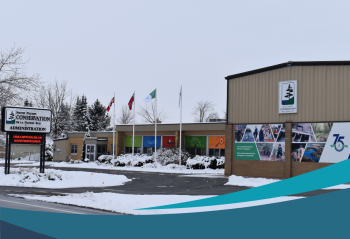
The South Nation Conservation (SNC) is reviewing the Ontario government’s proposal to significantly restructure the province’s environmental oversight system by amending the Conservation Authorities Act and consolidating Ontario’s 36 conservation authorities into seven regional bodies.
The proposal, posted on the Environmental Registry of Ontario (ERO #025-1257) on November 7, 2025, is open for public comment until December 22, 2025.
Province Proposes Seven Regional Conservation Authorities
The Ministry of the Environment, Conservation and Parks say the existing network of 36 authorities has created “fragmented” policies, inconsistent timelines, and uneven levels of technical capacity. To address these issues, the province is proposing to create the Ontario Provincial Conservation Agency, a new board-governed body that would provide centralized oversight. Conservation authorities would then be consolidated into seven large regional agencies, each aligned to major watershed systems: Lake Erie Regional Conservation Authority, Huron–Superior Regional Conservation Authority, Western Lake Ontario Regional Conservation Authority, Central Lake Ontario Regional Conservation Authority, Eastern Lake Ontario Regional Conservation Authority, St. Lawrence Regional Conservation Authority, and Northeastern Ontario Regional Conservation Authority.
SNC would fall under the proposed St. Lawrence Regional Conservation Authority, encompassing watersheds that drain into the St. Lawrence River, including today’s South Nation and Raisin Region jurisdictions.
The province states that the new system would continue to focus on natural hazard management, flood forecasting, permitting, and watershed health, but with greater consistency, more digital tools, and faster approvals.
SNC Warns of Loss of Local Governance and Rural Representation
SNC, however, is urging caution.
The organization emphasizes that Conservation Authorities were designed as locally governed, watershed-based agencies created and funded by municipalities, a model that reflects real hydrology and local priorities. Today, municipalities fund roughly 97 per cent of SNC’s operations, with provincial support having dwindled to 3 per cent.
SNC warns that the proposed restructuring could erode local accountability, rural representation, watershed-specific science and technical expertise, donor trust related to conservation lands, bilingual service obligations, and municipal service agreements and emergency response capacity.
SNC argues that consistency and modernization can be achieved without removing local governance or creating large regional bodies that may be distant from community needs.
Services Continue Uninterrupted
Despite the uncertainty, SNC stressed that all watershed programs remain fully operational across its 4,480-km2 jurisdiction. These include natural hazard permitting, watershed planning, flood forecasting and low-water response, drinking water source protection, forestry, restoration, and stewardship, agricultural cost-share programs, and management of more than 13,000 acres of conservation lands.
SNC notes that conservation authorities are the only environmental agencies with “boots on the ground,” conducting site visits, local monitoring, and emergency response in coordination with municipalities and landowners.
Concerns About Transparency and Service Impacts
SNC also flagged the limited detail provided in the province’s proposal. Municipalities and Indigenous communities received minimal notice, and no cost-benefit analysis, transition plan, or clarity on land transfers and municipal agreements has been provided.
The organization points out that provincial reports, including the Housing Affordability Task Force, do not identify conservation authorities as a barrier to development, and SNC’s own permitting process already meets or exceeds provincial timelines, issuing more than 98 per cent of permits on time.
SNC warns that full consolidation could increase costs, disrupt services, and divert resources away from frontline conservation during a period of growing climate-driven natural hazards.
Donor Lands and Bilingual Services at Risk
Much of SNC’s land base was donated by local residents with the expectation of permanent, local stewardship. Transferring these lands to a larger regional body could jeopardize charitable trust obligations, donor intent, conservation easements, and municipal agreements.
As the only bilingual conservation authority in Southern Ontario, SNC also cautions that any change must protect French-language services under the French Language Services Act.
Province Seeks Feedback on Boundaries, Governance, and Transition
The Environmental Registry posting outlines the criteria used to draw the new regional boundaries, including watershed alignment, municipal relationships, capacity balancing, and service continuity.
The province is asking the public and municipalities to comment on several key questions, including what factors would support a successful regional transition, how regional governance should be structured, how budgeting should remain transparent, and how to maintain strong ties with local communities.
SNC Encourages Public Input
SNC will submit formal comments alongside its member municipalities and Conservation Ontario, and encourages residents to participate in the public consultation by December 22, 2025.
“Healthy watersheds are the foundation of healthy communities and strong local economies,” SNC said, noting that modernization should build on the strengths of existing conservation authorities rather than replace them. “SNC supports the province’s goal of improving service delivery, strengthening natural hazard management, and enhancing digital permitting tools to help streamline the development process.”
The ERO posting and full details on the proposed regional boundaries can be viewed at ERO Notice #025-1257.