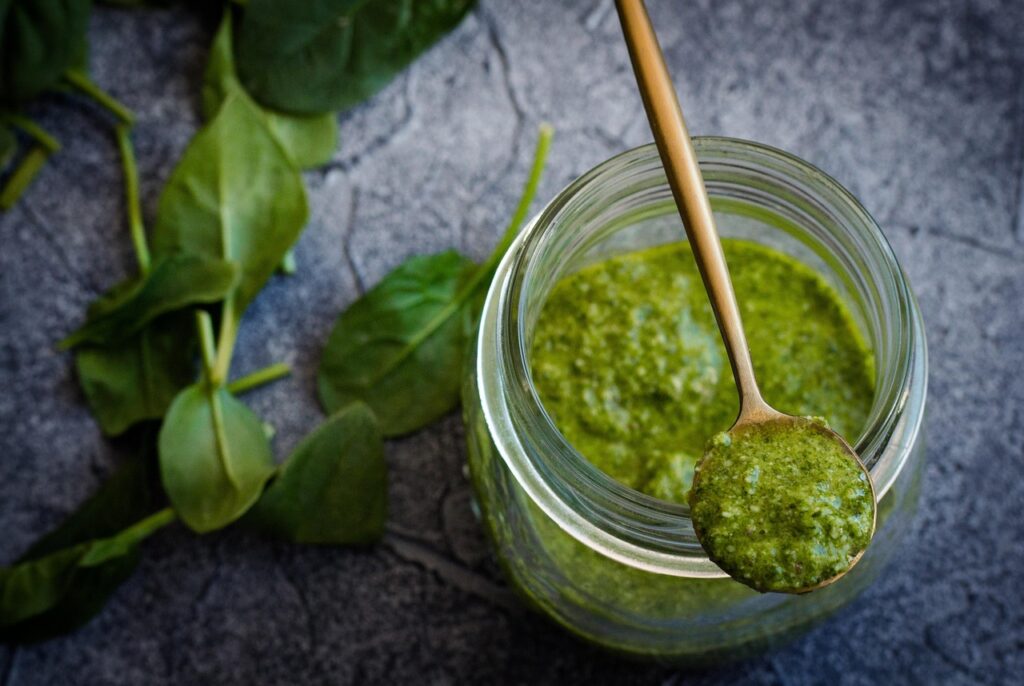
Seeing it at grocery stores and having received a large, leafy bunch from a friend’s garden, I can only surmise that with good summer heat basil is blossoming beautifully in the area.
Whether you shop for it at your favourite store, source it a local market garden stand, or grow it on your apartment balcony or patio, this herb is a true wonder of aroma and flavour – and it’s ripe for pesto treatment in your kitchen.
Pesto tradition
A traditional Genoese preparation, pesto is simply delicious. The word derives from the Italian word for “pounding,” and as such is related to the pestle half of the mortar and pestle, the ancient grinding and mashing tool found in many cultures.
With notes of tarragon, anise and even cloves, there are nearly a dozen types of basil – a member of the mint family – and each can have different flavour notes.
As a wonderfully sharp uncooked sauce, the brilliantly verdant green pesto is made with very fresh basil, usually pine nuts, garlic, a piquant cheese such as Pecorino or Parmigiano-Reggiano and rich olive oil.
Sourcing good ingredients is key to preparing a good pesto alla Genovese, the Ligurian pesto sauce.
So important is the sauce that Italy, within the European Union, has designated Ocimum basilicum, the Genovese gigante cultivar, an herb of protected origin (Denominazione di Origine Protetta).
Hard-core Italian pesto makers harvest their crop early and select sprouts of new growth that have only three leaves.
With the bounty of basil that you can currently find, pesto is a classic sauce for pasta that, while it requires getting a pot of water boiling, is a refreshing summer plate if there ever was one.
Pesto’s rich history
As for aromatic plant itself, the original plant likely came from Africa through India.
While it was certainly known to ancient Romans, the plant really got a foothold in Liguria. The varieties there carry with them more of the clove-like aromas, as compared to the anise and licorice ones that we know in our Thai basil.
Interestingly, it wasn’t until the 1960s and 1970s that pesto appeared in North America.
Pesto has been made with the grinding action of the mortar and pestle for centuries, but today cooks use a food processor – making it an even more simple dish than it already is.
However, the respective actions of grinding and cutting very finely produces a slightly different flavour when the ingredients are exposed to the air and when it becomes a part-emulsion with the olive oil.
Any way you slice it, pesto has a rich history. It’s said that Genovese sailors, having left their homes in the capital, located in the mezzaluna-shaped “Italian Riviera” province of Liguria in northwest Italy, wanted a full-bodied and flavourful dish when they returned home.
And, true to form, pesto from Genoa, if prepared according to original recipes, would be quite sharp and aggressive on the palate. (Its cousin from nearby Provence, pistou, is milder.)
Pesto can be a rich dollop added to minestrone soup or on pastas such as the traditional string-like trenette al pesto and gnocchi alla Genovese.
Use either a food processor, a blender or a mortar and pestle. The food history of the preparation is such that it was thought to be impossible to chop the basil finely enough, so it needed to be mashed and pounded down into the finest possible bits using a pestle.
To make basil pesto, however, you don’t need a mortar and pestle: a blender or a food processor will do.
Tedious though it must have been, chefs who are sticklers for detail and tradition insist that the larger, coarser veins in the basil leaves should be removed. That’s a hard and tedious-seeming thing to think about doing, so you can skip that step when you are making pesto.
Otherwise, while pine nuts are the traditional ingredient, walnuts do quite nicely: toast them lightly in large pan, but don’t let them burn.
For serving on pasta, add the pesto (at room temperature) to the warm noodles and toss.
Walnut basil pesto
Ingredients
1¼ cups washed and dried basil leaves, lightly packed
¼ cup chopped walnuts, lightly toasted (don’t let them burn)
1 clove garlic or to taste
¼ – 1/3 cup of light olive oil
4-5 tablespoons of grated Parmesan or Pecorino cheese
1 teaspoon freshly squeezed lemon juice
A few grates of lemon zest
A few red pepper flakes
Salt and pepper to taste
Method
Whiz together basil and walnuts in food processor or blender (if you’re not using a mortar and pestle, that is). Add garlic and buzz together; add olive oil and incorporate.
Whiz in the cheese stopping to scrape down the sides of the bowl. Add remaining seasonings, taste and adjust. Store in sealed container in fridge.
Bring to room temperature and add more olive oil if needed before using.
Cook your pasta and add the room-temperature pesto and toss.
Food writer Andrew Coppolino lives in Rockland. He is the author of “Farm to Table” and co-author of “Cooking with Shakespeare.” Follow him on Instagram @andrewcoppolino.