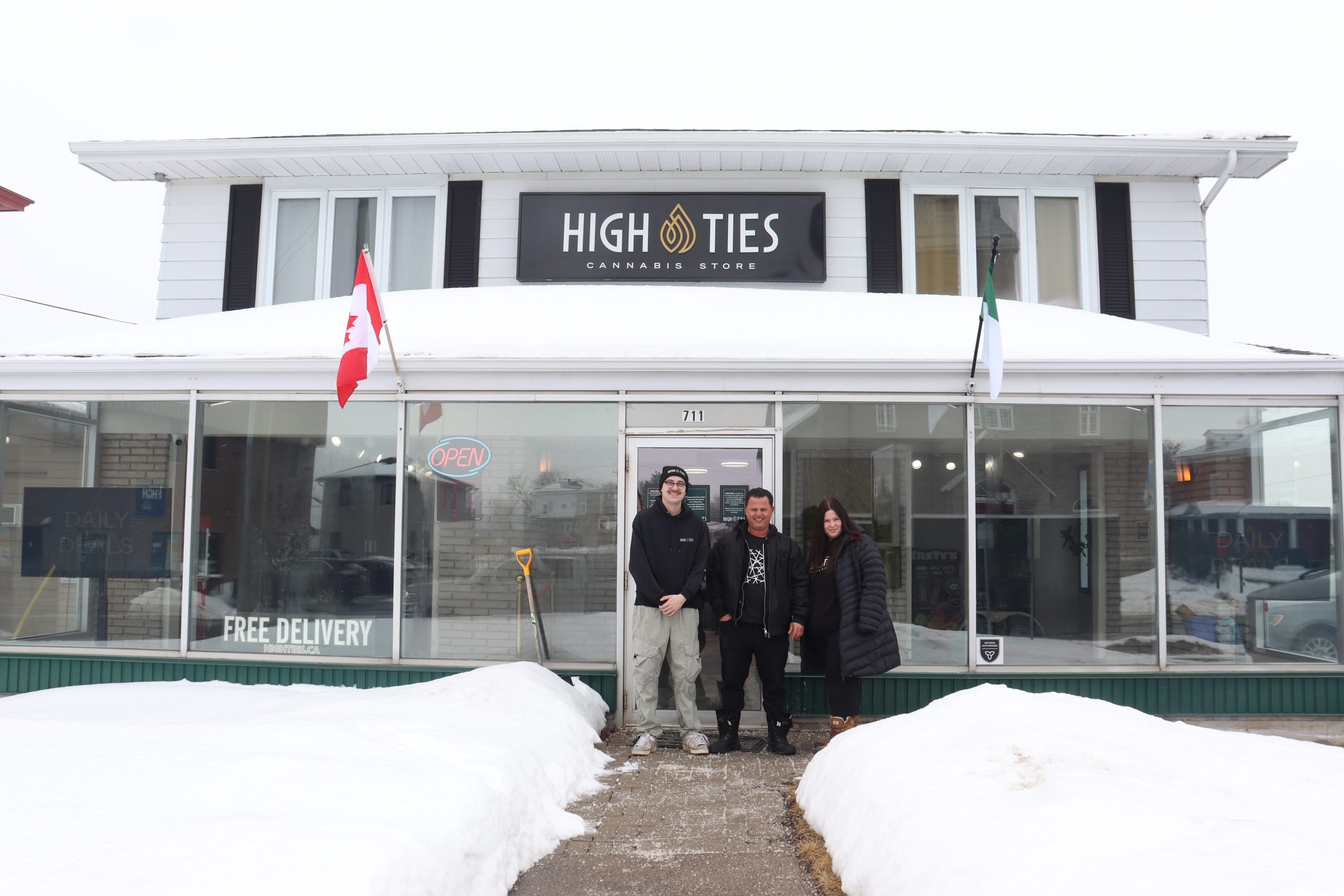
From left to right: Jonathan Levac, worker at High Ties, Will Chaar, owner of High Ties, and Lina Chaar Delorme, general manager at High Ties. (Gabrielle Vinette, EAP)
Disclaimer: The following article was written by our journalist as sponsored content and was paid for by High Ties Cannabis Dispensary.
Casselman residents no longer need to travel outside the community to purchase regulated cannabis products, as the municipality’s first dispensary is now officially open.
Following a council decision in late 2025, the first cannabis retail store in Casselman, High Ties Cannabis Dispensary, opened its doors on Decembre 29, 2025, marking a significant change in local policy and access to legal cannabis.
Municipal council voted to allow the establishment of cannabis retail stores within Casselman on Novembre 18, 2025, ending years of restrictions that had previously kept dispensaries out of the municipality. The opening of High Ties represents the first concrete result of that decision, bringing cannabis retail into the community for the first time.
The store is owned by Will Chaar, founder of High Ties, a company established in 2020. Day-to-day operations are overseen by general manager Lina Chaar Delorme, who has worked with the company since 2021.
Chaar remarks that the opening in Casselman aligns with the company’s broader mission of bringing regulated cannabis retail into smaller communities.
“My goal was to bring cannabis to small towns,” he said.
A focus on communities outside major cities
Chaar explained that his interest has long been in serving municipalities outside major urban centres rather than concentrating solely on large markets.
High Ties have stores in Alexandria, Blackburn, Ottawa, Casselman, Embrun, Plantagenet, Orleans, Vanier, and Vars.
Chaar noted that when cannabis legalization expanded across Ontario, many businesses rushed into the industry with rapid expansion plans.
“Everybody has the same idea,” he said, describing the competitive nature of cannabis retail in the province.
Chaar also described his background outside the cannabis sector, explaining that he comes from a construction industry career and continues to work in that field alongside managing the retail business.
That experience, he said, helped him navigate the practical challenges of opening a new storefront, including working with municipal processes and ensuring the location met all regulatory requirements.
Council approval and community engagement
Before opening in Casselman, High Ties representatives were required to engage with the municipality and council as part of the approval process.
Chaar said conversations with municipal staff eventually led to the opportunity to present directly before council.
The company outlined how the store would operate, what security measures would be in place, and what potential benefits cannabis retail could bring to the community.
“We put together a plan detailing the positive contributions our business can have,” he said.
Chaar emphasized that a central argument was the importance of replacing illegal cannabis sales with regulated, government-approved products.
“A big point in our presentation was taking people off the black market,” he explained.
He argued that legal cannabis stores provide safer access for adults while supporting oversight, taxation, and compliance with provincial standards.
Council ultimately voted in favour of allowing cannabis retail, a decision Chaar described as a milestone not only for the business but also for Casselman’s evolving approach to cannabis legalization.
After years of refusing retail stores, he said, the municipality appeared ready to move forward.
“It’s time,” he recalled.
Pride in being first
For Chaar, opening the first cannabis store in Casselman carried symbolic importance.
He described the feeling as a point of pride and recognition.
“When you’re the first in the community, it’s like an award,” Lina Chaar Delorme said.
Chaar noted that while cannabis stores are now common across Ontario, Casselman’s situation was different because the municipality had initially resisted allowing them.
As a result, he said, opening the first dispensary came with both responsibility and heightened public attention.
High Ties, Delorme added, wanted to ensure that residents felt the store was a legitimate part of the community rather than an outside business simply moving in.
Community response mostly positive
Delorme acknowledged that cannabis retail can still generate mixed reactions, particularly among residents who remain uncomfortable with the idea of a dispensary operating locally.
However, she said the response in Casselman has been overwhelmingly supportive.
“I would say 98 per cent has been more positive than negative,” she said.
According to Delorme, many customers expressed relief that they no longer needed to drive to neighbouring communities such as Embrun, Ottawa, or other towns to purchase legal cannabis.
“People told us, ‘Thank God you’re here. I don’t need to go somewhere else,’” she said.
She added that some concerns remain and may still associate cannabis with negative stereotypes or view it as a harmful substance.
Despite that, she believes attitudes are gradually changing as cannabis becomes more normalized and regulated.
Creating a welcoming environment
Delorme said High Ties places a strong emphasis on customer service and creating a comfortable atmosphere for residents who may be visiting a cannabis store for the first time.
“We try to welcome our customers like they’re coming into our home,” she said.
Staff aim to treat customers as guests rather than simply processing transactions, she explained, and work to reduce stigma by encouraging questions and providing guidance.
She said this approach is particularly important because some customers still feel hesitant or embarrassed about purchasing cannabis products.
“Customer service is number one,” she said. “That’s what separates us.”
Regulated products and public safety
Chaar and Delorme bring emphasis on regulated cannabis as a safer alternative to unlicensed products. Chaar said one of the main motivations for opening in small communities is to reduce reliance on illegal cannabis sources.
“Our products are regulated. They’re certified. They’re clean,” Delorme said.
High Ties sells a wide range of cannabis products, including dried flower, pre-rolls, edibles, beverages, concentrates, topicals, vaporizers, and accessories.
Delorme noted that Ontario regulations limit edible potency, with most individual servings capped at 10 milligrams of THC, though products may be sold in multi-packs with individually sealed portions.
Strict policies to prevent underage sales
Chaar and Delorme also stressed that cannabis retail stores operate under strict provincial rules, particularly regarding sales to minors.
High Ties enforces a firm identification policy.
“Anyone who looks 30 and under absolutely needs to be ID’d,” she said.
The store requires government-issued identification and does not accept photocopies or images on phones.
Staff are also trained to watch for situations where adults may attempt to purchase cannabis on behalf of minors.
“It does happen,” Delorme said, adding that the store monitors such risks closely through security systems and staff vigilance.
Looking ahead for cannabis retail in Casselman
As cannabis retail becomes established in Casselman, Chaar expects the industry will continue to evolve with new products and shifting regulations over the next several years.
He believes some stores across Ontario may eventually close as competition increases, leaving fewer but stronger operators.
For High Ties, he said, the priority remains affordability, quality, and community integration.
“We want to make them feel comfortable, respected,” Delorme said.
Chaar also expressed appreciation for residents’ patience during the store’s construction and opening process, noting that many community members were eager for the dispensary to open before the holidays.
They would like to thank the community for their ongoing support.
High Ties ultimately opened shortly after Christmas, bringing legal cannabis retail to Casselman for the first time.
Now operating in Casselman, the company hopes to remain a long-term part of the community’s evolving landscape.